Hot
Select options
This product has multiple variants. The options may be chosen on the product page
Price range: D108.00 through D180.00
+5% vat will be applied at checkout
Plant Type – Small, clumping palm species.
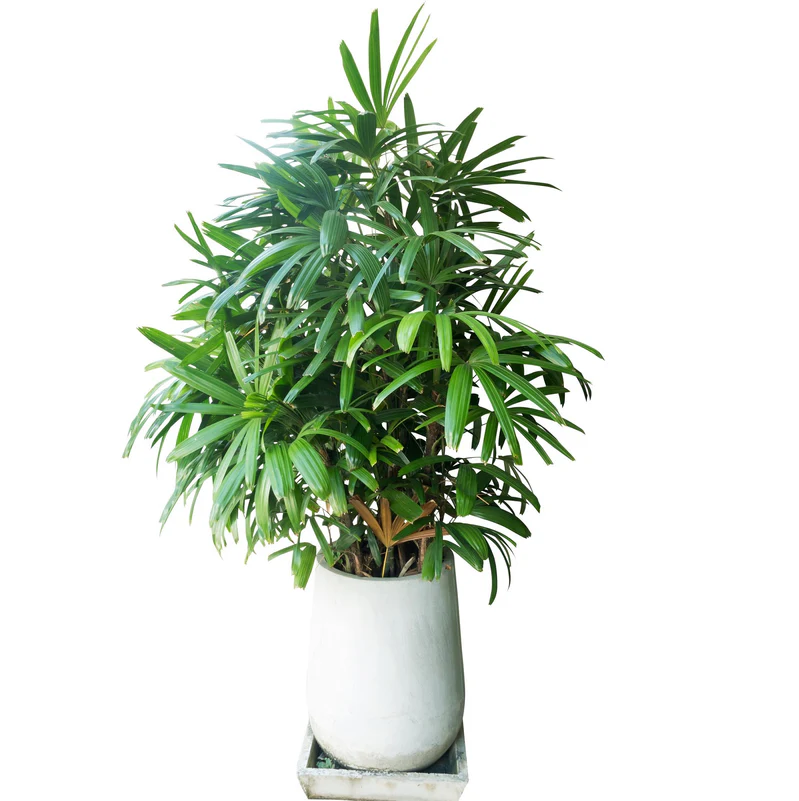
Stems & Foliage – Upright green stems with glossy, fan-shaped fronds.
Fronds – Each divided into 5–8 narrow, lance-shaped segments.
Growth Habit – Forms dense clumps, ideal for pots and landscapes.
Adaptability – Thrives in tropical, subtropical, and indoor settings.
Care – Requires regular watering and feeding; reduce in cooler months.
Uses – Popular ornamental plant for homes, offices, and gardens.
Climate Tolerance – Adapts to a wide range of soils and environments.
Rhapis excelsa is the most well-known and widely cultivated species, easily adapting to most interiors, and used in both tropical and subtropical landscapes throughout the world. The lady palm (Rhapis excelsa) is a small palm species that grows in dense clumps of slender upright green stems. On the stems are fan-shaped, glossy green fronds that each have between five and eight narrow, lance-shaped segments.
Their care isn’t overly complicated, though you will have to establish a regular watering and feeding routine. Plan both to water and feed more during the warmer months of the year and then back off slightly during the cooler months. Rhapis adapts to a wide range of climates, soils, and environments, making the “Lady Palm” popular for many applications.
1. What is Rhapis Excelsa?
It’s an indoor Lady Palm known for its upright fan-shaped leaves and slow, steady growth.
2. How much light does it need?
It prefers bright, indirect light but can adapt to lower light conditions.
3. How often should I water it?
Water when the top layer of soil feels dry. Keep the soil slightly moist but never soggy.
4. What type of soil works best?
A well-draining mix with peat and perlite helps the roots breathe.
5. Does Rhapis Excelsa need fertilizer?
Feed once a month during spring and summer with a balanced liquid fertilizer.
6. Is it safe for pets?
Yes, Rhapis Excelsa is generally considered non-toxic to cats and dogs.
| Size | 100cm – 120cm (Pot: 10L), 60cm – 80cm (Pot: 08L) |
|---|


Ayesha –
Beautiful and low-maintenance! My Rhapis Excelsa made my living room look so elegant
Sara –
Premium-looking plant with lush, broad leaves. Perfect for indoor décor
Hina –
Added this to my office and it transformed the whole space. Very easy to care for
Maria –
Lovely plant
Zara –
Gives such a classy, tropical vibe at home. Definitely a must-have