
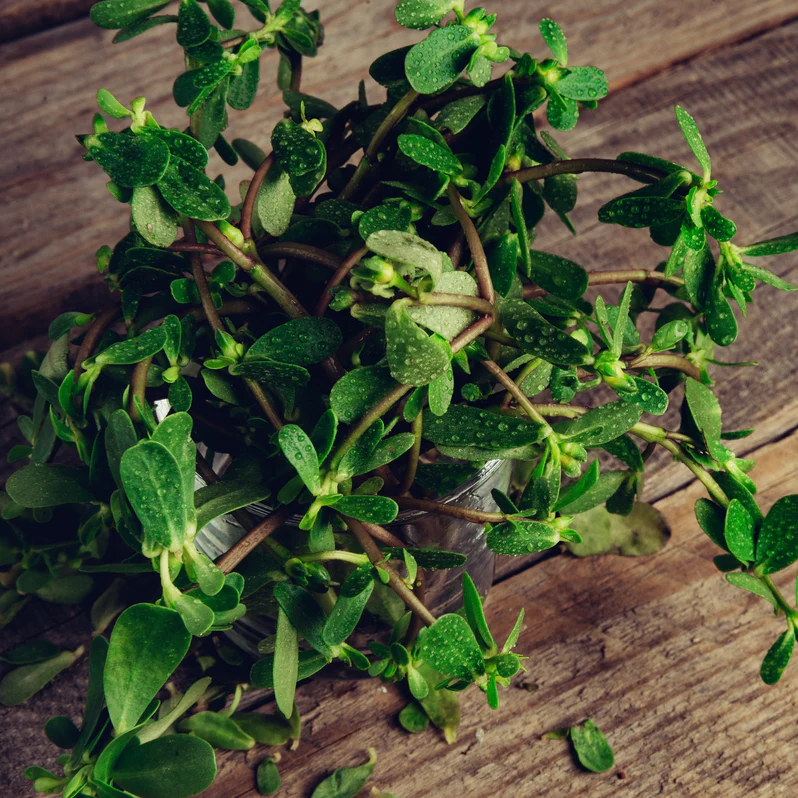
Sea Purslane Sesuvium Portulacastrum (Shoreline Purslane/Dampalit)
D2.40
+5% vat will be applied at checkout
-
Growth Habit – Evergreen, prostrate perennial forming dense mats of trailing stems.
-
Foliage – Succulent, fleshy, elliptic-ovate leaves that turn yellow with age or intense sun.
-
Flowers – Small, pink to purple blooms that appear continuously through the season.
-
Adaptability – Grows well in coastal areas, tolerating saline and sandy soils.
-
Groundcover Use – Excellent for erosion control, water-wise landscapes, and seaside gardens.
-
Versatile Planting – Suitable for containers, hanging baskets, or as a trailing spiller.
-
Propagation – Stems root easily at nodes, helping the plant spread quickly.
-
Size – Can grow up to 30 cm tall with stems reaching 1 meter in length.
-
Low Maintenance – Hardy, drought-tolerant, and easy to cultivate.
-
Global Presence – Found widely in coastal regions across the world.
Sea Purslane or Sesuvium Portulacastrum is a groundcover that is overgrowing. Sesuvium portulacastrum is a supple prostrate, evergreen perennial that forms the appearance of a mat of smooth trailing stems of reddish-green that branch out regularly. They are surrounded by succulent, fleshy, elliptic-ovate leaves that turn aged and yellow or in full sun. Pink flowers with a small, dazzling appearance are blooming more or less continuously all through the season.
Sea Purslane is a rapidly developing coastal groundcover or trailing vine with stems that tend to root at the nodes. It is easy to cultivate and can also be used as a groundcover for water-wise landscapes and seaside gardens. Sea Purslane can also be planted in containers or as a spiller with a texture or a very long trailing hanging basket plant.
Sesuvium portulacastrum, also known as Shoreline seapurslane, is a vigorous perennial plant found in coastal regions throughout the world. The name shoreline purslane often refers to it. It can grow up to thirty centimeters (12 in) tall, with large smooth stems as long as 1 one meter (3.3 feet) long. It is soft and glossy, with fleshy green leaves, either lanceolate or linear, with a range of 10-70 millimeters (0.39-2.76 in) long and 2-15 millimeters (0.079-0.591 in) broad. The flowers are purple or pink.
Faqs
-
What type of sunlight does Sea Purslane need?
Full sun to partial shade is best for healthy growth. -
How often should I water Sea Purslane?
Water moderately; it tolerates dry and saline conditions well. -
What type of soil is ideal for Sea Purslane?
Well-draining sandy or loamy soil with some salinity is preferred. -
Can Sea Purslane grow near the sea?
Yes, it thrives in coastal areas and salty soils. -
Is Sea Purslane edible?
Yes, both leaves and stems can be eaten raw or cooked. -
How do I propagate Sea Purslane?
Propagate via seeds or cuttings in well-drained soil for best results.
| Size | 10cm – 15cm (Pot: V9) |
|---|
Related products


Neem Tree – Natural Shade and Medicinal Outdoor Tree UAE
Neem Tree – Natural Shade and Medicinal Outdoor Tree UAE
D560.00
Select options
This product has multiple variants. The options may be chosen on the product page
Snake Plant (Sansevieria) – Air Purifying Indoor Plant UAE
Snake Plant (Sansevieria) – Air Purifying Indoor Plant UAE
Price range: D40.00 through D75.00
20 cm
85 cm

